The Brief Said "Brand Film." What We Actually Needed to Make Was Something Else.
There is a moment that happens on almost every project. Not always on the first call, sometimes on the second, occasionally not until the recce. The client shares what they want. A two-minute brand film. Something that captures the company's journey. A video for the website and the annual day presentation. And then, somewhere in the conversation, something else surfaces. A quieter thing. A truer thing. The real story that was sitting underneath the brief the whole time.
This piece is about that moment, and why learning to find it changes everything about the film you end up making.
When the Brief Is Right But the Story Is Wrong
A good brief is not the same as a good story. A brief can be thorough, clearly written, well-intentioned, and entirely focused on the wrong thing.
This is not the client's fault. Most organisations are not in the business of finding stories. They are in the business of making things, serving people, solving problems. When they come to a brand film production company in India with a brief, they bring what they know: their achievements, their timeline, their messaging priorities, their stakeholder requirements.
What they often cannot see from the inside is what an audience on the outside will actually find compelling. That gap between what an organisation wants to say and what an audience wants to feel is where most brand films quietly fail.
At Qurious, we think of the brief as the starting point of a conversation, not the end of one.
The Three Questions We Ask Before We Accept Any Brief
In our experience working across documentary, corporate, and brand film projects in India, the brief that arrives in our inbox is rarely the brief we end up working from. Not because it is wrong, but because it is incomplete in ways the client cannot always see themselves.
Before we commit to a creative direction on any brand film or corporate film project, we sit with three questions.
What is the audience supposed to feel, not just know?
Most briefs are built around information transfer. The company was founded in this year. It operates across these many cities. It stands for these values. This is important context, but it is not a story. Feeling precedes belief, and belief precedes action. A brand film that only informs has done the easier half of the job.
Who is the most human character in this story?
Every organisation, however large or institutional it might feel from the outside, has people at its centre. A founder who took a specific risk at a specific moment. A worker whose daily reality reveals something essential about what the organisation actually does. A beneficiary whose life changed in a way that cannot be summarised in a statistic. Finding that person, or that moment, is almost always where the real film lives.
What is the one thing this film must do?
Not the five things it should cover. Not the three messages it needs to land. The one thing. If someone watches this film and does nothing else, what should that one film have made them feel or decide or do? This question is uncomfortable for organisations that have multiple stakeholders and multiple objectives. But it is the question that separates films that work from films that are merely complete.
A Story About Questioning the Brief
Recently, we were in conversations with an organisation whose name I'll keep confidential. Let's call them Organisation X.
The brief sounded familiar. They wanted a film that showcased the scale of their work. Multiple programmes, multiple geographies, years of effort, measurable impact. On paper, it made perfect sense. If you've invested years building something meaningful, of course you want people to see the breadth of it.
As we spent more time with the team, a different pattern began to emerge.
Whenever we asked people why the work mattered, the conversation rarely stayed on the programme itself. It drifted towards individual stories. Someone spoke about a young person who had started believing in possibilities they hadn't considered before. Another spoke about confidence returning where there had once been hesitation. Someone else described a change that was difficult to measure but impossible to miss.
Those were the moments everyone spoke about with energy. Not the activities. Not the numbers. Not the scale.
The people.
At one point, I remember saying something along the lines of: "I don't think the story here is the programme. I think the programme is simply the vehicle for something deeper."
The room went quiet for a moment. Then people started nodding.
The brief had asked for a film about what the organisation was doing. What we were hearing, again and again, was a story about what was becoming possible because of it. That single shift changed how we thought about the film. We stopped trying to cover everything and started looking for the moments that revealed the larger truth underneath the work.
Whether or not that specific creative direction ultimately gets made exactly as envisioned is almost secondary. What mattered was that the conversation had moved from documenting activity to understanding meaning.
And in our experience, that's where most worthwhile films begin.

What Happens When You Question the Brief Together
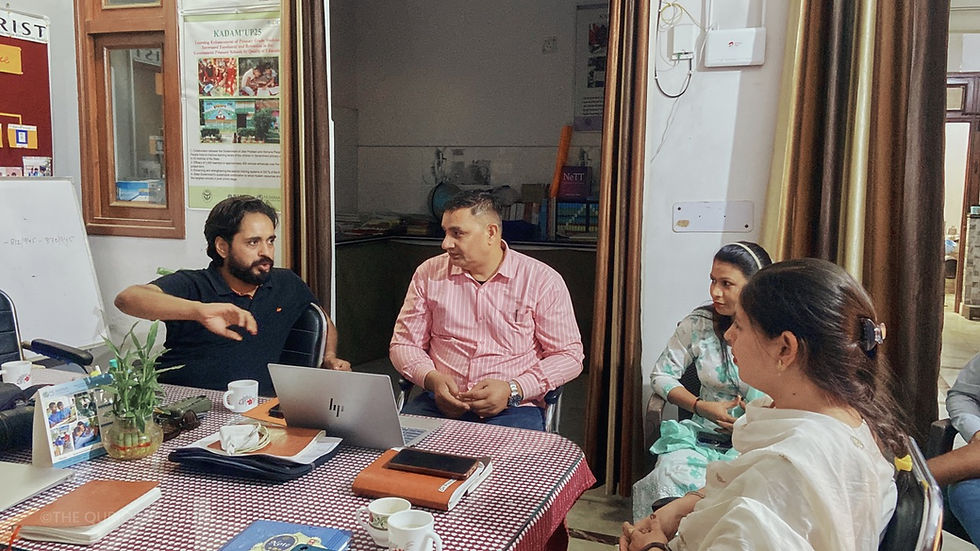
Pushing back on a brief sounds like a confrontational act. In practice, when it is done with genuine curiosity rather than ego, it is one of the most collaborative things a production partner can do.
The clients who have had the most satisfying experience working with us are almost always the ones who came in open to discovering what their story actually was, rather than arriving with it fully formed. They gave us access. They let us ask uncomfortable questions. They trusted that the process of finding the story was part of the value, not a detour from it.
What emerges from that process is a brand film brief that is no longer just a document. It becomes a shared understanding. The client knows why every creative decision was made. The production team knows what the film is really for. And the audience, who will never see the brief, feels the result of that clarity in every frame.
That is the difference between a brand film that gets filed away and one that keeps circulating long after the campaign it was made for has ended.
If Your Next Brand Film Should Be Something Else
If you are preparing a brief for a corporate or brand film project in India, here is a suggestion before you finalise it. Set aside the format, the duration, the platform. Ask yourself what story you would tell if you were not trying to impress anyone. If you were just trying to show someone, honestly, what your organisation is and why it matters.
That answer is usually closer to the film worth making than anything written in a brief.
At Qurious, we work with organisations that are willing to have that conversation. The brief is where we start. The story is what we go looking for together.
Working on a brand or corporate film and not sure if you have found the right story yet? Let us talk.


Comments