What "Story-First" Actually Means (And What It Doesn't) | Story-First Filmmaking India
By The Qurious Studio
Every production company says it now. Story-first. Storytelling at our core. We lead with story. The phrase has become so common in the film and video production industry in India that it has nearly lost its meaning entirely. It appears in agency decks, on studio websites, in pitch presentations, almost always without explanation.
We use it too. It is on our website and it is genuinely what we believe. But precisely because we believe it, we think it is worth being specific about what story-first filmmaking actually means when it is not just a marketing line, and what it produces that a brief-execution approach does not.
What It Does Not Mean
Before getting to what story-first filmmaking is, it is worth clearing away what it is not, because the confusion is part of why the phrase has lost traction.
Story-first does not mean cinematic. A film can be beautifully lit, elegantly graded, and cut to emotionally precise music and still have no story worth following. Production value is not storytelling. A high budget and a strong story are independent variables, and confusing them is one of the more expensive mistakes a production company can make on a client's behalf.
Story-first does not mean long. Some of the most complete and moving stories we have encountered could be told, properly, in ninety seconds. Some of the emptiest films we have seen run to twelve minutes. Duration is a structural decision. It has nothing to do with whether a story exists at the centre of a film.
Story-first does not mean emotional manipulation. Adding a swelling score under a slow-motion shot of someone's face is not storytelling. It is a technique. When it is applied to footage that was never going to move anyone, it produces something that feels manipulative precisely because the emotion was not earned. A story-first approach earns the emotion through the material itself, not through the grade and the music laid over it afterward.

What It Actually Means: Three Practices
Story-first filmmaking is less a philosophy statement and more a set of operational habits. Here is what it actually looks like across three stages of a project.
In the brief stage: story-first means asking before assuming.
When a client comes to us with a brief for a corporate or brand film in India, our first job is not to respond to the brief with a treatment. It is to sit with the brief long enough to find out what question it is not yet answering. What is the story this organisation has that no other organisation could tell? Not the message they want to send, the story that is already true and waiting to be found.
This often involves asking questions that feel slightly beside the point. About the people inside the organisation. About the moment the work felt most real to someone. About the detail that everyone on the inside takes for granted but that an outsider would find quietly extraordinary. The story lives in the answers to those questions. The brief usually points somewhere adjacent to it.
In the shoot stage: story-first means following what is actually there.
A shot list is a plan. A story-first shoot carries the shot list lightly and stays alert to what the location, the subject, or the moment is actually offering. This requires a kind of attentiveness that is hard to build into a schedule, which is why production companies that work quickly and efficiently by default tend to produce films that feel efficient rather than alive.
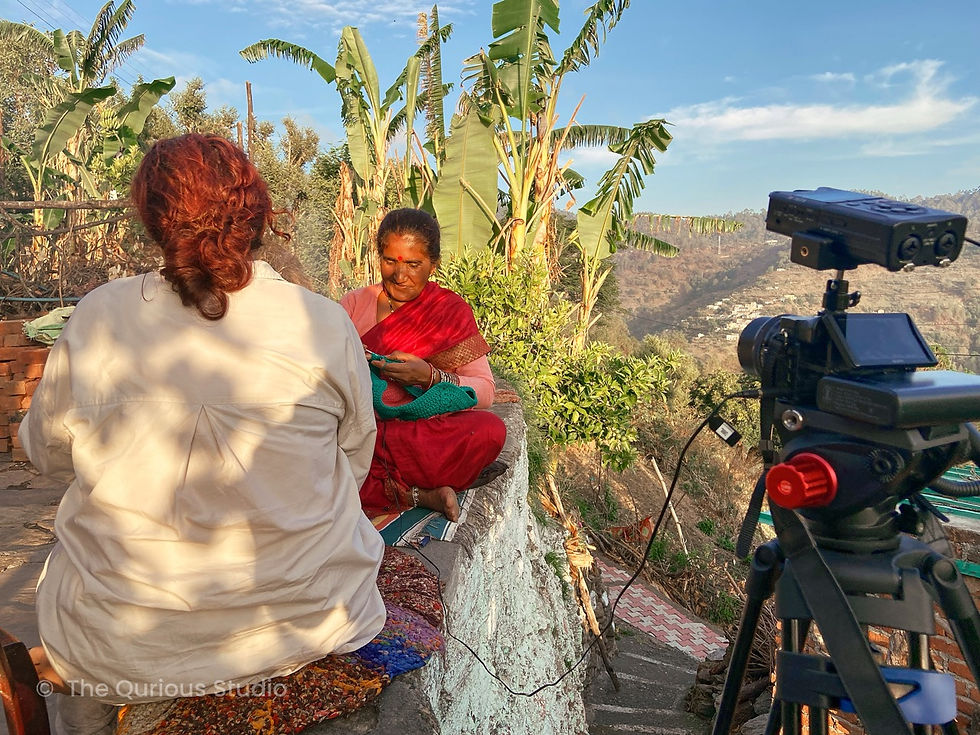
At Qurious, we protect time in every shoot for the moment that was not in the brief. Not because we are underprepared, but because we know that moment is coming and we want to be ready for it when it arrives. Every film we are most proud of contains something we did not plan.
In the edit stage: story-first means building by emotional logic, not chronological order.
The edit is where story-first filmmaking either holds or collapses. An edit driven by chronological sequence, this happened, then this happened, then this happened, produces a record. An edit driven by emotional logic, what does the viewer need to feel at this moment, and what comes next to deepen or complicate that feeling, produces an experience.
This is the difference between a film that informs and a film that moves. Story-first editing asks, at every cut: is this moment earning its place, or is it here because it was in the brief?

Why This Matters for the Client
For an organisation commissioning a documentary, corporate, or brand film in India, the practical difference between a story-first partner and an execution-focused partner shows up in a few very specific ways.
A story-first partner will ask more questions in the early stages than feels strictly necessary. They will push back on a brief element if it conflicts with the story's clarity. They will occasionally suggest a direction you did not expect. These are not signs of a partner who is difficult to work with. They are signs of a partner who is genuinely trying to make a film that works, rather than one that simply satisfies the brief on paper.
The films that come out of a story-first process tend to be harder to explain in a one-line summary, and far easier to watch. They are the ones that get forwarded, that resurface at events years after they were made, that do the work of building trust with an audience that was not already looking for you.
The Only Question That Matters
At the start of every project, we come back to the same question: what is the story that only this organisation, with these people, in this context, could tell?
If we cannot answer that question, we are not ready to shoot. The equipment, the schedule, and the crew are all secondary to that answer. Everything else in a film, every stylistic decision, every structural choice, every frame, is in service of that story once it is found.
That is what story-first filmmaking means to us. Not a positioning line. A constraint we place on our own process, project after project, because it is the only reliable way to make work we are willing to put our name on.
Looking for a story-first film production partner in India? Let's start with the story.


Comments